14
Partner research institutions
14
Partner research institutions
3
Use cases in rare diseases
8
European countries involved
Why we do it
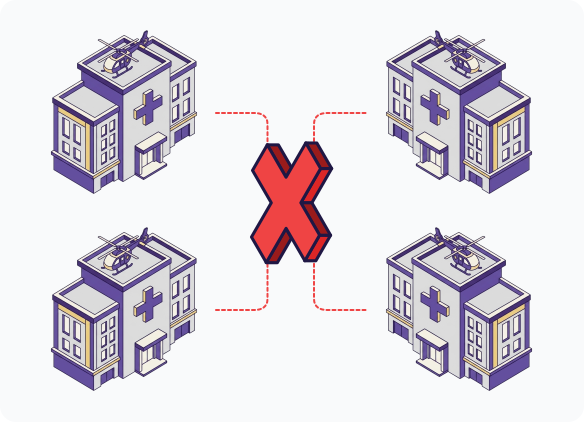
GDPR and national regulations prohibit centralized sharing of sensitive health data across institutions and borders. At the same time, research questions about rare diseases require large sample sizes.
The solution is fundamental gap how to enable cross-border health research studies while maintaining the promise of GDPR.
The better approach
A federated algorithm is developed on researcher workstations.
The algorithm is dispatched to participating institutions.
Computations run on local infrastructure on FAIR-prepared data.
Only privacy-preserving aggregated results leave institutions.

Use cases at launch
Three diverse areas selected for their unmet therapeutic needs and real world healthcare relevance, building upon existing European expertise.
Use case 1
Integrating genomic and phenotypic data from diverse European cohorts to identify shared pathways and potential therapeutic targets.
View use caseUse case 2
Combining clinical and genomic information across rare disease registries and biobanks to characterize genotype-phenotype correlations.
View use caseUse case 3
Multi-modal data integration — clinical, genomic, metabolic and environmental — identifies predictive risk factors.
View use caseTechnology & standards
Train AI models across institutions without moving patient data.
Findable, Accessible, Interoperable and Reusable health datasets.
Platforms for Analytics and Distributed Machine Learning for Enterprises.
Open-source Personal Health Train infrastructure for federated analysis.
Privacy-by-design architecture aligned with European data regulation.
Federated training of clinical, genomic and multi-modal models.
Consortium
A pan-European consortium uniting academic research institutions, clinical centres, technology SMEs and a coordinating AI company.